
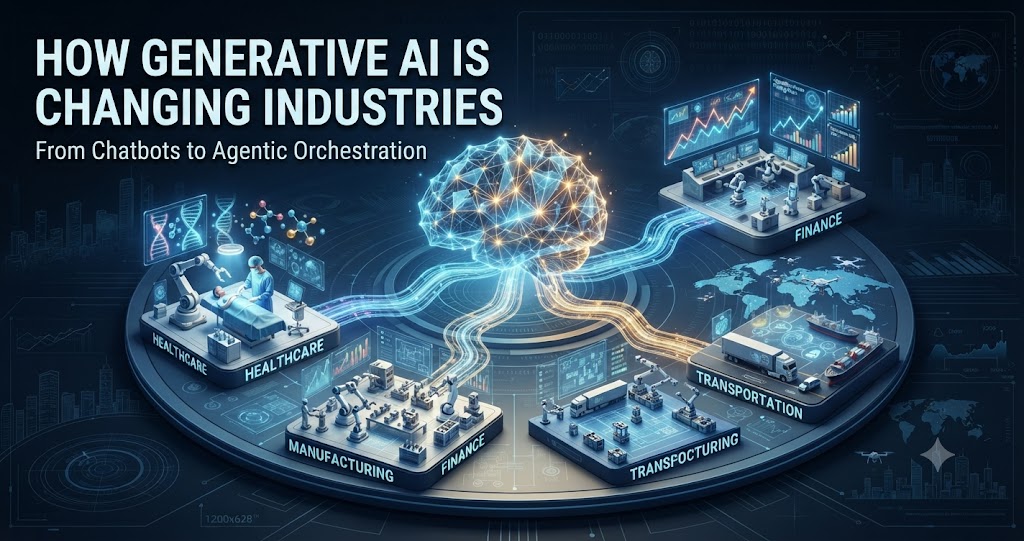
In 2026, generative AI has graduated from a creative novelty to the operational backbone of the modern enterprise. We are no longer discussing “AI-assisted tasks”; we are witnessing the fundamental redesign of business logic, where Agentic AI systems autonomously plan, execute, and optimize complex, multi-step workflows across every major sector, shifting the competitive advantage from mere adoption to architectural integration.
The Evolution: From Chatbots to Agentic Orchestration
For years, organizations treated AI like a digital intern—useful for drafting an email or summarizing a meeting, but requiring constant human supervision. That era is over. The 2026 landscape is defined by Agentic AI.
Unlike standard Large Language Models (LLMs) that respond to singular prompts, these agents possess:
- Long-term Goal Execution: They independently manage end-to-end processes, such as researching, booking, and adjusting full supply chain logistics.
- Inter-agent Communication: Specialized agents now “talk” to one another, coordinating workflows between finance, HR, and IT systems without manual handoffs.
- Self-Correction Loops: These systems monitor their own output, cross-checking results against established constraints and real-time data to minimize “hallucinations.”
Industry-Specific Transformations
The impact of GenAI is not uniform; it is surgically precise, disrupting specific bottlenecks in diverse sectors.
| Industry | Primary Transformation | Key Outcome |
| Healthcare | Autonomous Diagnostics & Simulation | Accelerated drug discovery and personalized treatment paths. |
| Finance | Real-time Risk & Fraud Auditing | Predictive adaptation to emerging threat patterns. |
| Manufacturing | Generative Design & Predictive Ops | Minimal material waste and automated maintenance schedules. |
| Marketing | Agentic Commerce | Hyper-personalized, continuous growth loops vs. static campaigns. |
Healthcare: Beyond Human Speed
In pharmaceutical R&D, models like the latest iterations of protein-folding AI are simulating molecular structures in minutes—tasks that previously occupied entire departments for years. In practice, this means clinicians receive AI-generated summaries of complex patient histories, integrated with genetic markers, to deliver treatments tailored to the individual rather than the “average” patient.
Manufacturing: The Smart Factory
Modern factories now leverage “Cognitive and Physical AI.” By feeding real-time sensor data into generative models, these systems don’t just alert managers to a machine failure; they proactively re-engineer assembly flows, generate new part designs to mitigate supply chain shortages, and update maintenance protocols autonomously.
The “Agentic” Workflow Framework
To capitalize on this shift, leading organizations are abandoning the “crowdsourced pilot” approach. Instead, they are adopting the “AI Studio” model.
1. The Centralized Hub: Stop letting departments build isolated AI experiments. Create a sandbox where reusable tech components—templates, agents, and deployment protocols—are vetted.
2. Human-in-the-Loop Oversight: In 2026, the most effective roles are not “AI operators” but “AI Orchestrators.” These are subject matter experts who define the constraints and review the agents’ outputs for high-stakes decisions.
3. Multi-Model Verification: For mission-critical workflows, use different model providers to “double-check” each other. This reduces the risk of bias or systemic error in automated decision-making.
Addressing the “ROI Paradox”
Recent data indicates a stark divide: 88% of organizations are using AI, yet 80% report no measurable impact on enterprise-level EBIT. The difference? The top performers are deploying AI across three or more business functions simultaneously, while laggards remain stuck in siloed pilots.
Common Bottlenecks to Avoid:
- The Pilot Trap: Staying in “testing mode” for more than three months.
- Lack of Governance: Failing to map unstructured data to specific, governed business outcomes.
- Misalignment: Attempting to automate tasks that don’t actually drive revenue or cost efficiency.
Frequently Asked Questions (FAQ)
Q: Will generative AI replace human expertise?
A: No, but it will change the nature of expertise. Human roles are evolving from “content producers” to “strategic orchestrators” who provide the ethical judgment and intent that AI currently lacks.
Q: What is the most significant risk in 2026?
A: Data opacity. As AI agents execute more decisions, the lack of “Explainable AI” (XAI) becomes a legal and operational liability. Companies must prioritize transparent, auditable decision-making processes.
Q: How do I measure the success of an AI initiative?
A: Move away from “adoption metrics” (e.g., number of seats) and toward “value metrics” (e.g., percentage of tasks resolved autonomously, reduction in R&D cycle times, or net cost savings per process).
Q: Is agentic AI ready for high-stakes decision-making?
A: It is ready for high-stakes tasks when implemented with human-supervised verification loops and robust testing. Never grant an agent autonomy in a high-risk scenario without clear “stop-loss” protocols.
Looking Ahead: The Symbiotic Enterprise
The goal for the next 12 months is not “more AI,” but “better-integrated AI.” By 2027, the gap between organizations that treat AI as a tool and those that treat it as a foundational architecture will likely be insurmountable. Start by consolidating your data flows, empowering your workforce to manage agents rather than perform rote tasks, and holding your AI investments to the same rigorous benchmarks as your human hires.