
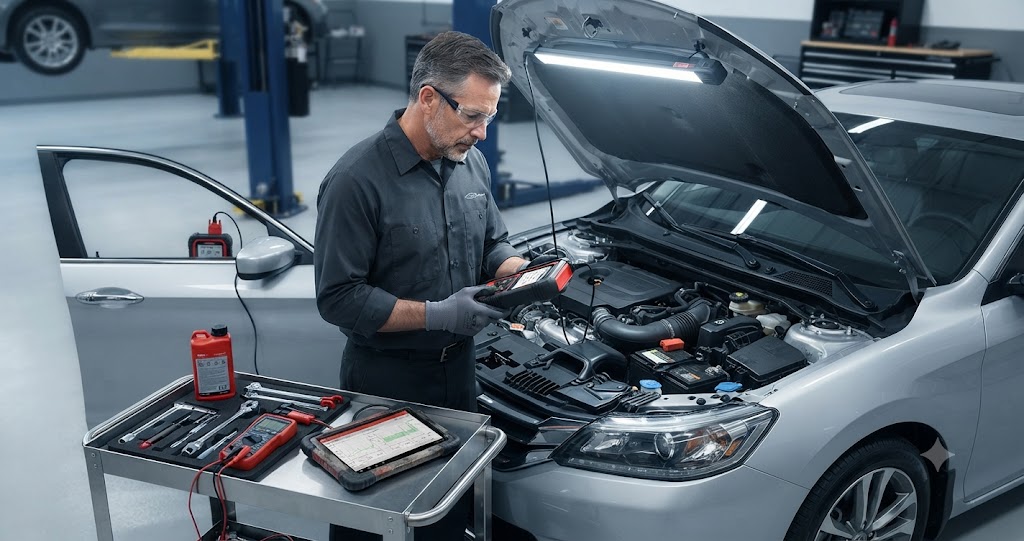
Car troubles often stem from identifiable mechanical or electrical failures. By systematically evaluating symptoms like warning lights, unusual noises, and performance drops, you can isolate the root cause. This guide provides a practitioner’s framework for identifying common vehicle malfunctions and determining whether they require professional intervention or can be resolved with DIY maintenance.
Key Takeaways
- Warning Lights: Never ignore the “Check Engine” light; it signifies a fault in the emissions or ignition system.
- Noises: Squealing often points to serpentine belts, while grinding signals brake pad wear.
- Fluid Levels: Regularly checking oil, coolant, and brake fluid prevents catastrophic engine failure.
- Maintenance: Adhering to your manufacturer’s service schedule reduces long-term ownership costs.
Engine Starting Failures: Electrical vs. Fuel
When the engine fails to turn over, the problem is rarely “the engine” itself. It is usually a failure in the delivery of energy or fuel.
- The Clicking Sound: A rapid, repeating click is the classic symptom of a discharged battery or a failing starter solenoid.
- Silence: If you turn the key and get zero response, check your battery terminals for oxidation (a white, powdery buildup).
Troubleshooting Framework: Starting Issues
| Symptom | Primary Suspect | Action |
|---|---|---|
| Rapid clicking | Battery / Terminals | Clean terminals; jump-start |
| Cranks but won’t start | Fuel pump / Spark | Check for fuel rail pressure |
| Engine turns very slowly | Starter motor | Inspect starter connections |
Deciphering Unusual Noises
Your car speaks through vibration and sound. Learning these “languages” is the fastest way to prevent a minor issue from becoming a total breakdown.
Squealing at Startup
This is almost always a loose or glazed serpentine belt. As the rubber ages, it loses friction. In practice, this means the belt slips against the pulleys until it warms up and expands.
Grinding During Braking
This is the “wear indicator” of your brake pads. If you hear metal-on-metal grinding, your pads are gone, and you are likely damaging the rotors.
Overheating: More Than Just Low Coolant
Overheating is the quickest path to a warped cylinder head. If your temperature gauge hits the “red,” pull over immediately.
The Cooling System Workflow
- Check for Leaks: Look for puddles of sweet-smelling, green or orange fluid under the car.
- Thermostat Check: If the engine overheats quickly but the radiator feels cool, your thermostat is likely stuck in the closed position, preventing coolant flow.
- Fan Operation: If the car only overheats while idling, the electric cooling fan or its relay is likely the culprit.
The “Check Engine” Light Explained
The Check Engine Light (CEL) is a broad signal. To fix it, you need the specific Diagnostic Trouble Code (DTC).
- Loose Gas Cap: A common, overlooked cause of a CEL. If the cap isn’t sealed, the EVAP system detects a leak.
- Oxygen Sensors: These report to the ECU how much fuel is burning. Over time, they become coated in soot, leading to poor fuel economy.
Common OBD-II Codes
| Code | Meaning | Likely Solution |
|---|---|---|
| P0300 | Random Misfire | Check spark plugs/coils |
| P0420 | Catalyst Efficiency | Inspect O2 sensor or catalytic converter |
| P0171 | System Too Lean | Clean mass airflow sensor / check vacuum |
Vibration and Handling Issues
Vibrations at specific speeds tell a distinct story about the chassis and tires.
- Steering Wheel Shakes at 60+ MPH: This is almost always a wheel balance issue. Your tires have lost their uniform weight distribution.
- Vibration Under Braking: Your brake rotors are likely warped. This happens when hot rotors are splashed with water or when the wheel lug nuts are overtightened unevenly.
Advanced Troubleshooting: The “Human-First” Approach
When you are staring at a complex engine bay, focus on the “Three Pillars of Combustion”: Air, Fuel, and Spark.
- Air: Is the filter clogged? Is there a vacuum leak?
- Fuel: Is the pump priming? Is the filter blocked?
- Spark: Are the plugs firing in the correct sequence?
By isolating these three, you can cut your diagnostic time in half. Always verify the simplest components—like a fuse or a loose wire—before assuming a mechanical failure like a broken timing belt or worn piston rings.
[Internal Link: Essential DIY Car Maintenance Tools]
In practice, this means building a baseline of data. Keep a log of when you last changed your oil, transmission fluid, and air filter. When a problem occurs, you can reference your [External Link: Manufacturer Maintenance Schedule] to see if a specific component has exceeded its operational service life.
What is the most common reason for a “Check Engine” light appearing on a dashboard?
The most frequent cause is a loose, damaged, or incorrect gas cap, which triggers the EVAP (evaporative emissions) system. However, failing oxygen sensors and worn-out spark plugs are also leading causes.
How do I know if my car’s battery is actually dead?
If you hear a rapid clicking sound when turning the key, your battery likely lacks the cold cranking amps required to start the engine. Use a multimeter; if it reads below 12.2V, it needs a charge or replacement.
Can I continue driving if my brake pads are squealing?
You should stop driving immediately. Squealing is a warning sign; if you progress to a grinding sound, you are damaging your rotors, which will significantly increase the cost of your repair.
Why does my steering wheel shake only at high speeds?
This is typically caused by wheel imbalance. If the shaking only happens while braking, it indicates that your brake rotors have become warped due to excessive heat or improper lug nut torque.